
Client:
Intuit, QuickBooks
Timeline:
Multi-year
Role:
Head of Design (Australia & Rest of World)
Scope:
AU + Global (200+ countries, 13 websites, 10 languages, 6 currencies)
Focus:
Design systems adoption, global brand governance, localisation strategy, operating models at scale
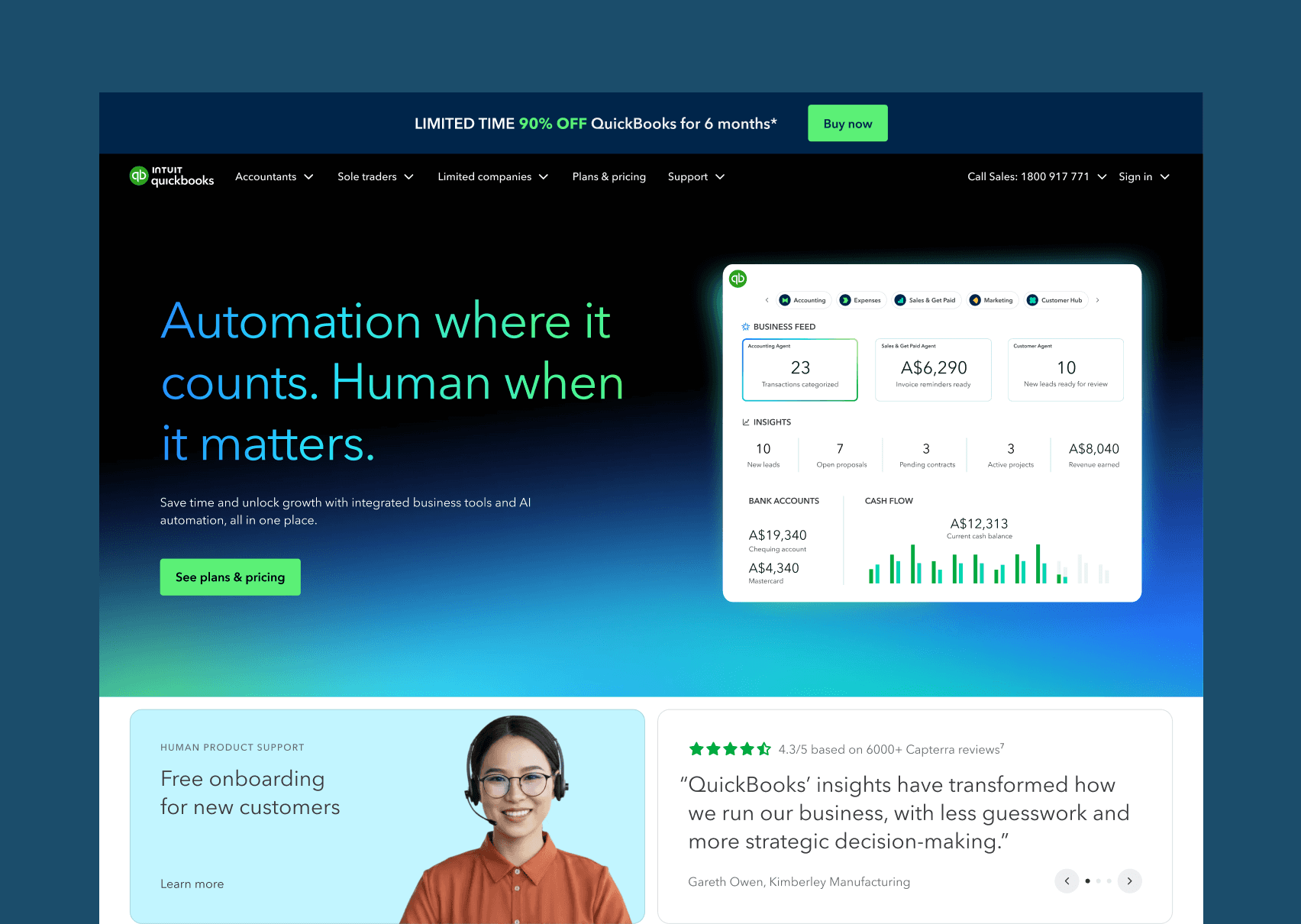
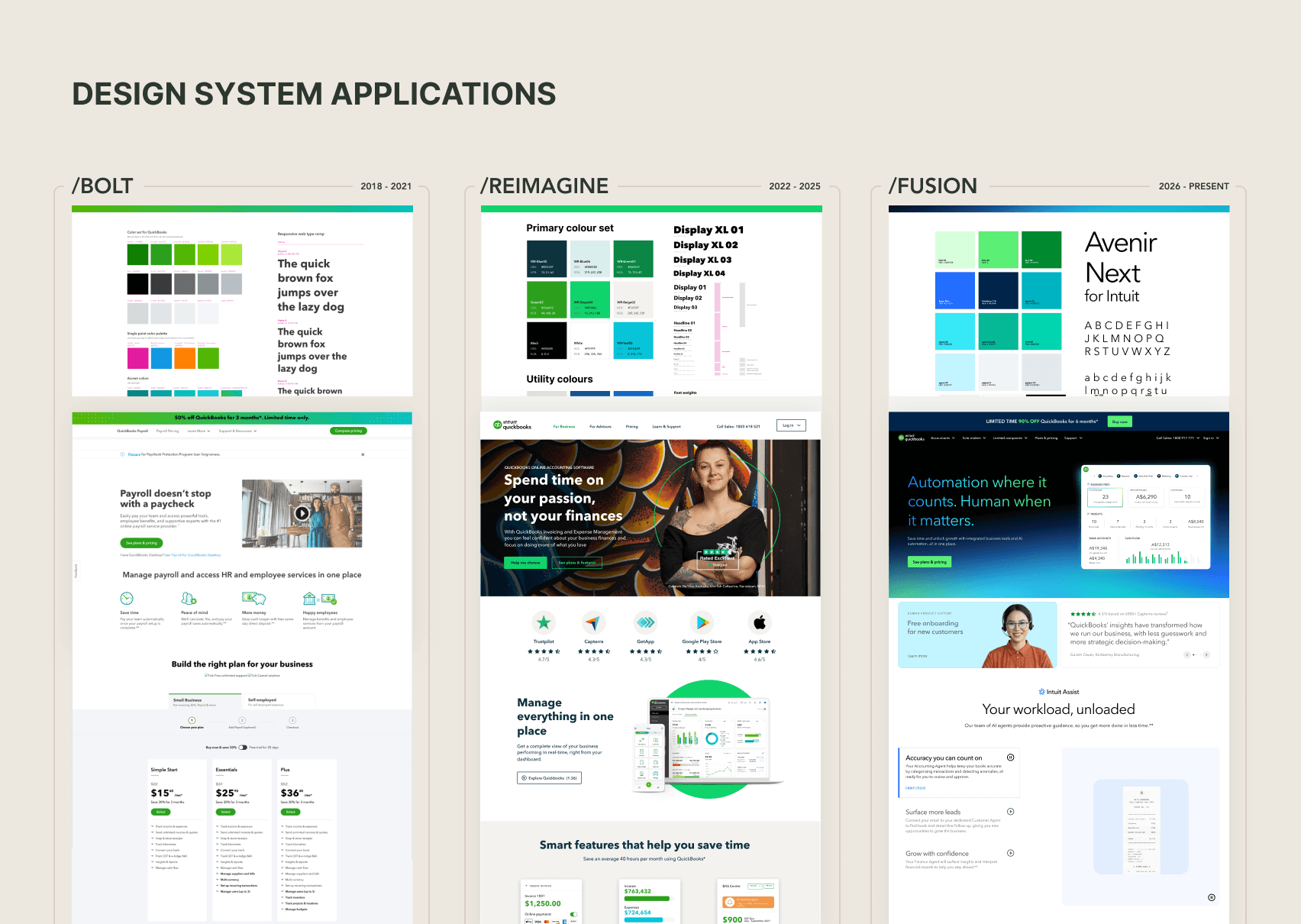
Over the course of my time at QuickBooks, the organisation underwent three major brand and design system transformations, which we referred to internally as: Bolt, Reimagine, and Fusion.
Each one represented a fundamental shift in visual language, component architecture, and design principles - and each one was conceived and owned centrally by US-based teams.
The challenge for regional markets like Australia and APAC wasn't just keeping up. It was avoiding the fate that global design systems so often inflict on non-primary markets: being handed a finished system and asked to make it fit. When that happens, localisation becomes a retrofit, brand consistency becomes a best effort, and regional teams become reactive rather than strategic.
My job across all three transitions was to make sure that didn't happen - and over time, to change the conditions that made it possible in the first place.
My involvement across Bolt, Reimagine, and Fusion wasn't uniform, it evolved deliberately, and that evolution is part of what makes this project worth telling.
This was my entry point into Intuit. I was purely executional - learning the system, understanding how global decisions translated into regional reality, and building the foundational knowledge that would inform everything that followed.
This was where I stepped into leadership for the first time on a transition of this scale. I moved from executor to regional project lead - directing how guidelines were interpreted and applied locally, advocating for APAC-specific requirements, and owning the rollout for AU and global-adjacent markets. I wasn't just implementing someone else's vision, I was shaping how it landed.
This was a different conversation entirely. By this point I had been promoted to Design Manager, and my influence shifted upstream. I was in the room during early component exploration - not reviewing finished work, but contributing to how critical elements like pricing cards and purchasing journeys came to life. I flagged regional dependencies - language expansion, currency display, compliance requirements - before they became problems rather than after. I attended a recurring APAC leadership meeting series to represent my team's progress, surface risks, and keep cross-geo delivery on track. All while I worked directly with global teams to ensure the Australia site was built to brief, on time, as part of one of the biggest product launches in Intuit's history.
Global design systems don't fail because of bad design. They fail because of incomplete representation.
At the time I also represented our global market (200+ countries that we referred to as Rest of World), for these markets, the risks were structural. Systems optimised for primary markets could unintentionally exclude global realities. Late-stage localisation introduced inconsistency, rework, and delivery risk and regional teams defaulted to being reactive implementers rather than strategic partners.
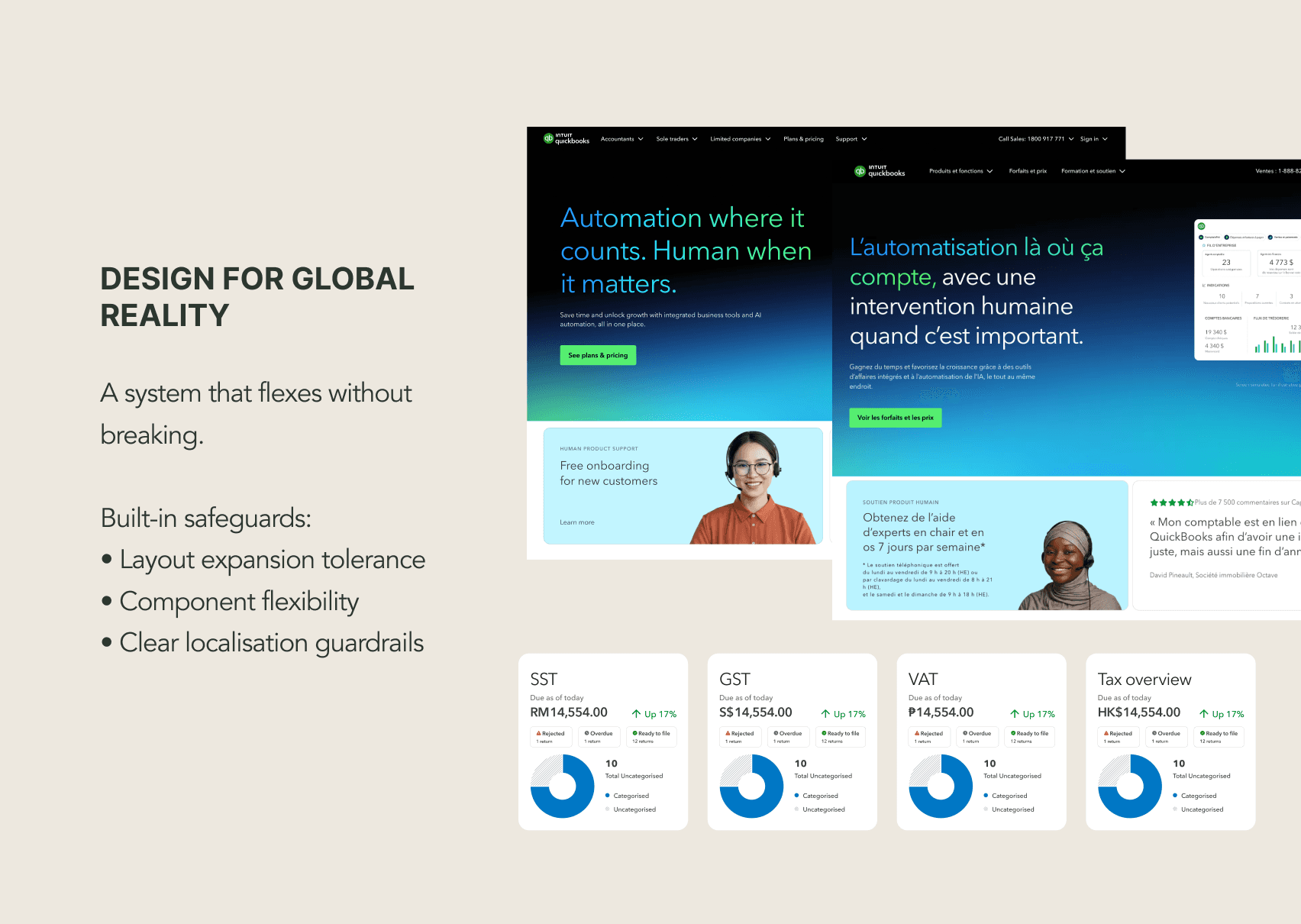
Across each transition I worked to reframe these from delivery challenges into design problems worth solving at the system level. That meant advocating for geo-agnostic patterns from the start - layouts that tolerated text expansion across 10 languages, pricing components that supported 6 currencies without bespoke builds, compliance-aware structures that didn't require regional overrides after the fact.
The goal wasn't uniformity, it was a system that could flex without breaking.
For each transition the operational challenge was significant - coordinating across time zones, teams, and competing delivery timelines while keeping day-to-day delivery running.
By Fusion, the team's ability to absorb and execute system transitions had matured considerably. We had more accurate scoping from prior experience, clearer localisation requirement lists, and a better-defined working model with global counterparts. Rollout sequencing improved and revision cycles shortened - not because standards dropped, but because the trust between our team and global stakeholders had grown to the point where they knew we'd get it right.
The Fusion launch alone required delivering:
4 product libraries comprising 56 product expressions, 512 widgets, and 34 videos - meeting US, UK, CA, and AU requirements simultaneously.
Alongside that, the team contributed to launch-critical landing pages including a full homepage redesign, an updated first-touch EDM series, and a Tier A brand campaign that produced 147 assets in its first phase. All of this ran in parallel with ongoing BAU delivery.
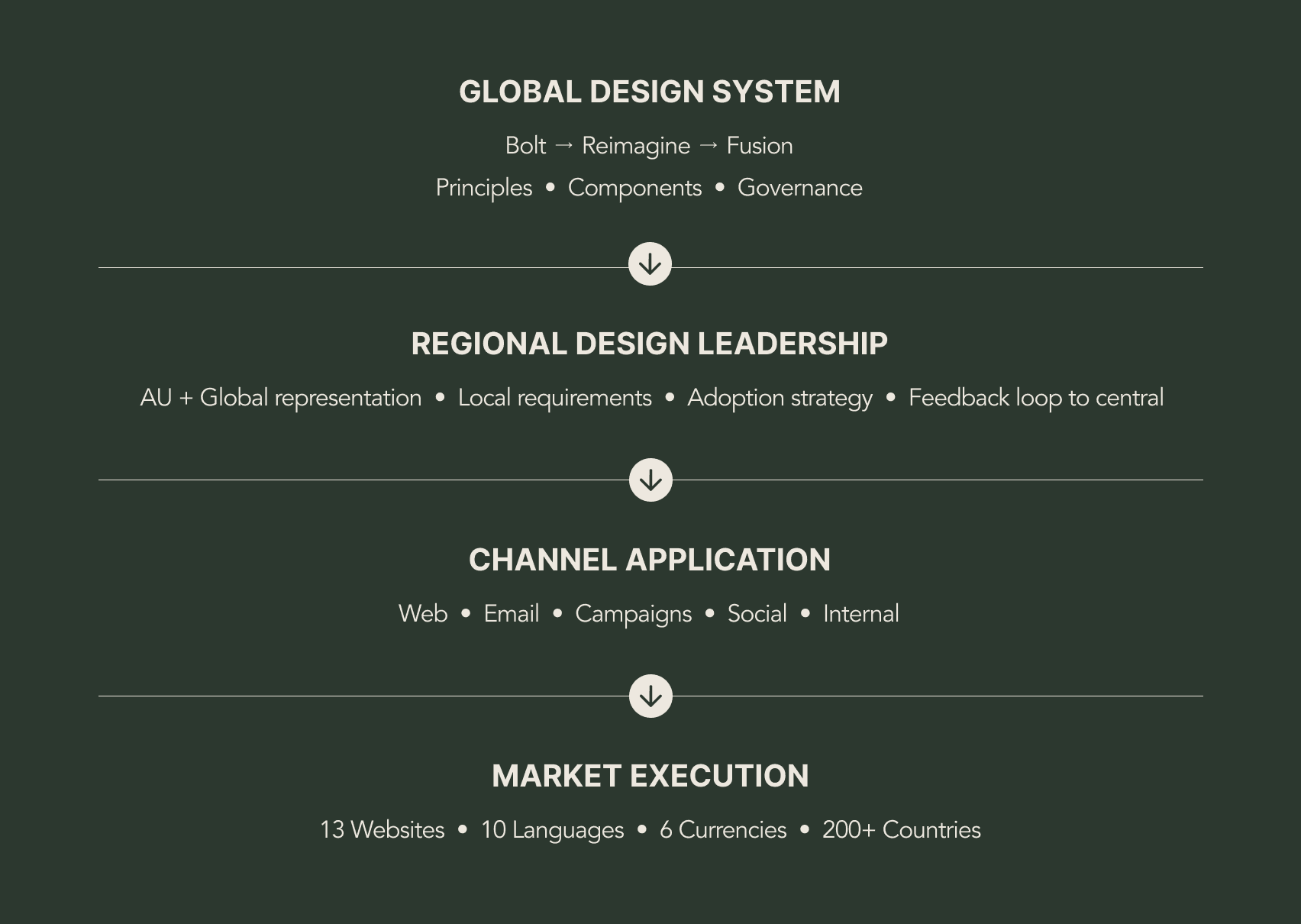
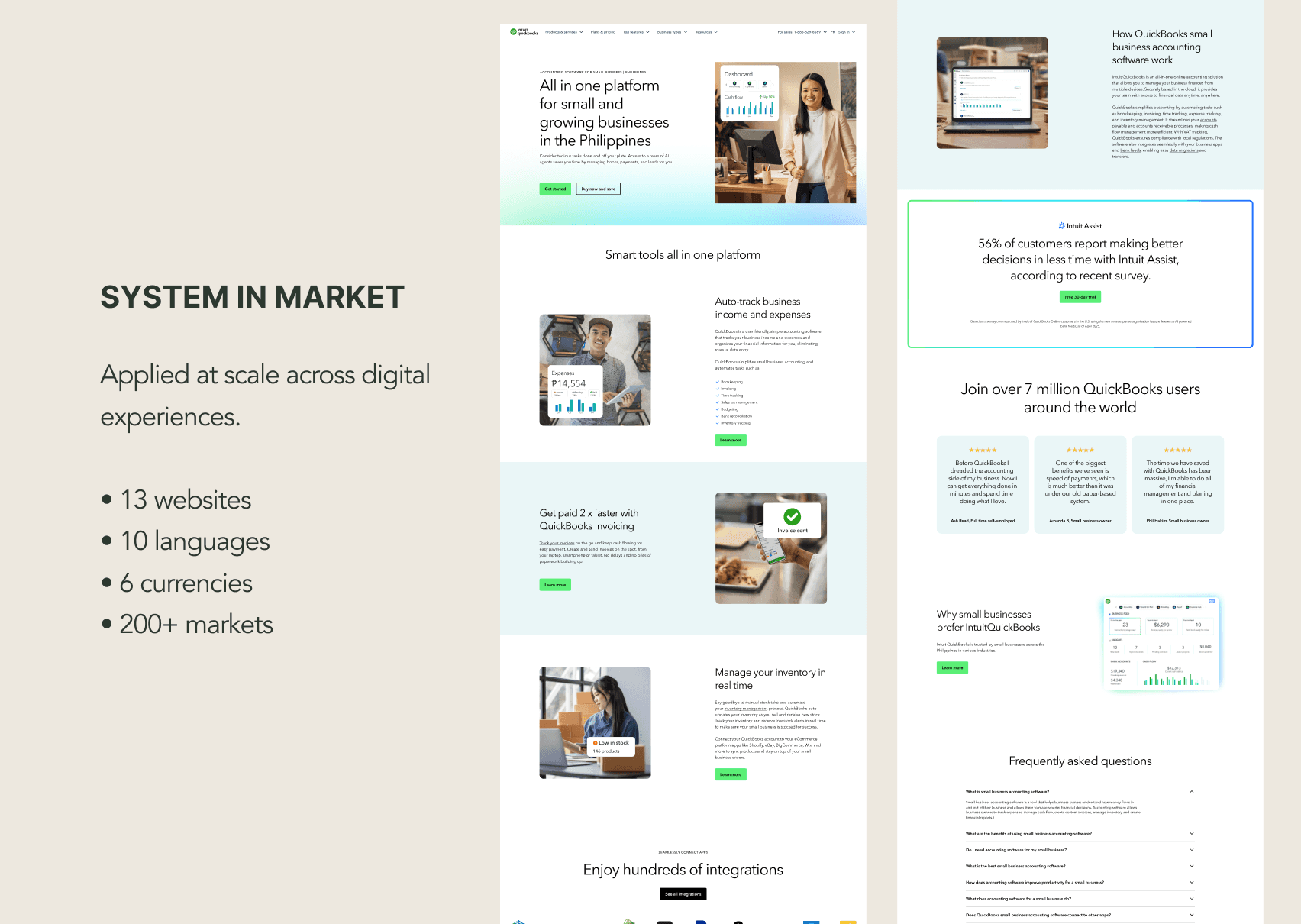
The operating model underpinning all three transitions: global system ownership flowing into regional design leadership, channel application, and ultimately market execution across 13 websites, 10 languages, 6 currencies, and 200+ countries.
Three distinct visual eras. Each one a complete system shift - new principles, new components, new brand expression. The consistency across them wasn't accidental.
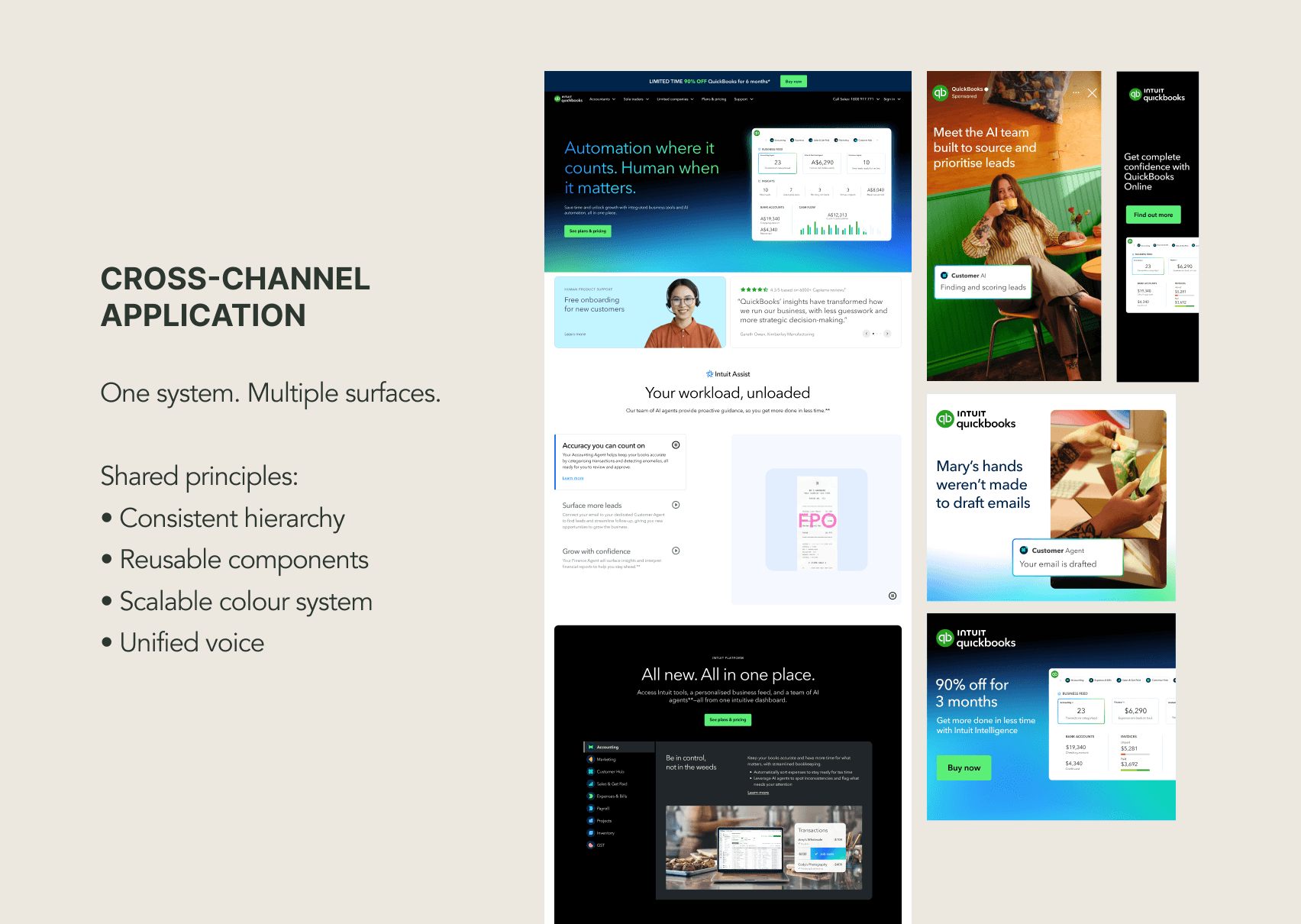
One system. Multiple surfaces. Web, email, campaigns, social, and internal - all held together by shared hierarchy, reusable components, and a unified voice.
The same system, applied in English and French. Layout expansion, typographic adaptation, localised CTAs - built in, not bolted on.
The system applied at scale: 13 websites, 10 languages, 6 currencies, 200+ markets. This is what design infrastructure looks like when it works.
Across Bolt, Reimagine and Fusion, the markets I was responsible for (AU and Global) successfully met every transition timeline while maintaining brand consistency across all major channels and markets.
But the more meaningful outcome was structural. By Fusion, my team team had shifted from being passive recipients of system decisions to active contributors to how those decisions were made. Regional requirements were designed into the system rather than retrofitted around it. The feedback loop between global vision and regional execution was clearer, faster, and more trusted than it had ever been.
The Fusion launch was recognised internally as the biggest product launch in Intuit's history. The design team's contribution - in scale, quality, and cross-geo coordination - was a significant part of why it landed the way it did.
Design systems are organisational systems. The patterns matter, but so does who's in the room when they're being made.
The most valuable thing I did across these three transitions wasn't the rollout work - it was changing where regional teams sat in the conversation. From the outside looking in, to a seat at the table before the decisions were finalised.
That shift doesn't happen by asking for inclusion. It happens by demonstrating over time that you understand the system deeply enough to improve it - and that your market's requirements make the system stronger, not more complicated.
That's the kind of design leadership I'm interested in building wherever I work next.