Client:
Intuit, QuickBooks
Timeline:
1 month
Role:
Head of Design (Australia & Rest of World)
Scope:
AU + Global (200+ countries, 13 websites, 10 languages, 6 currencies), scaled to US, UK, CA
Focus:
Mobile-first design strategy, growth experimentation, cross-geo systems, conversion optimisation
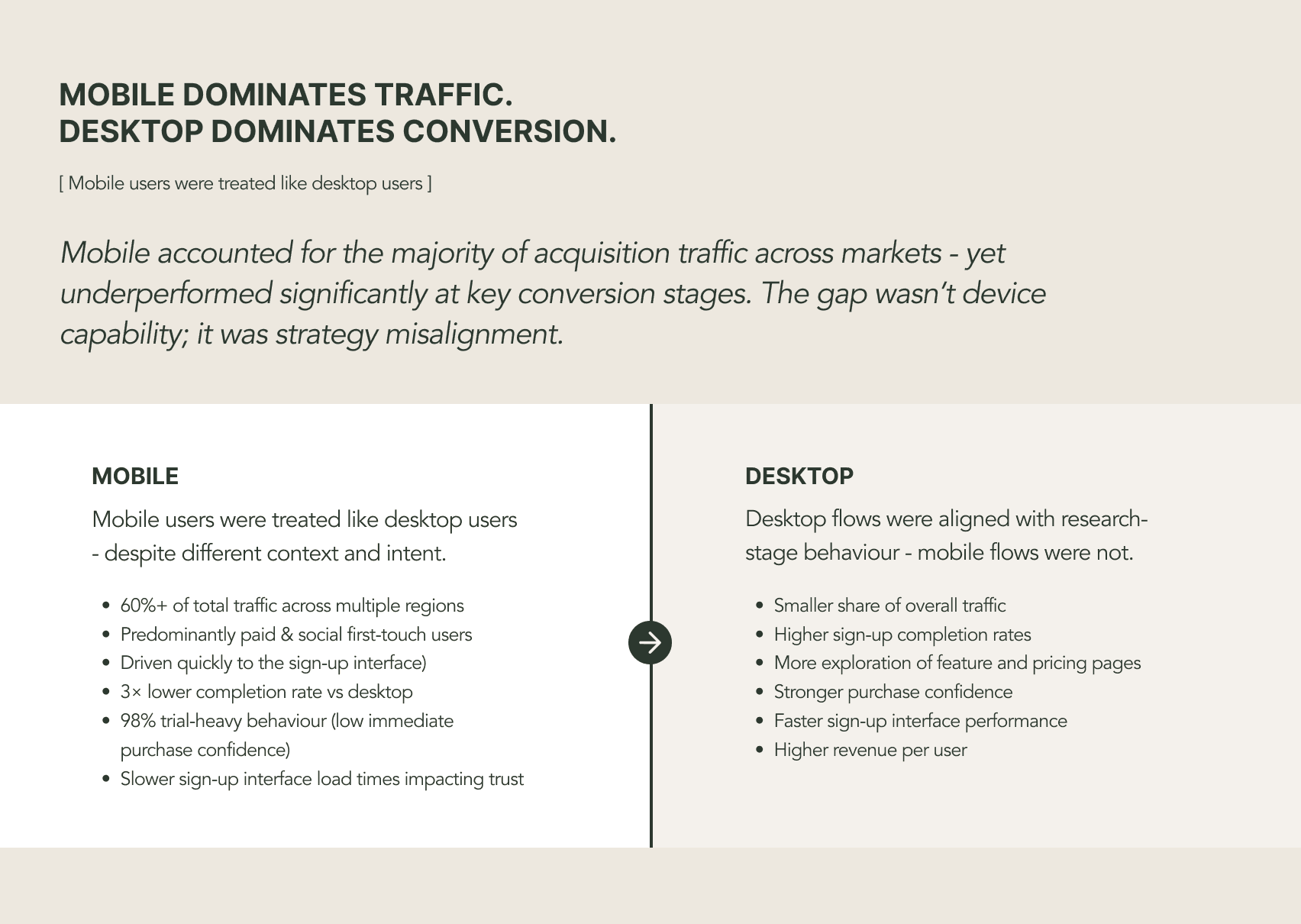
Across Australia, Global, the UK, and Canada, mobile accounted for more than 60% of total acquisition traffic. And yet mobile conversion consistently, significantly, underperformed desktop.
The instinctive read on that gap is a design quality problem - mobile experiences that aren't good enough.
The real read, once we looked at the data carefully, was a strategy problem. Mobile users weren't failing to convert because the screens were bad - they were failing to convert because the experience was designed for the wrong mindset.
Mobile users - arriving predominantly from paid and social channels, often encountering QuickBooks for the first time - were being pushed immediately toward sign-up CTAs and a sign-up interface that loaded materially slower on mobile and completed at rates up to three times lower than desktop. They were in a fact-finding, evaluative headspace. The experience was treating them like they'd already decided.

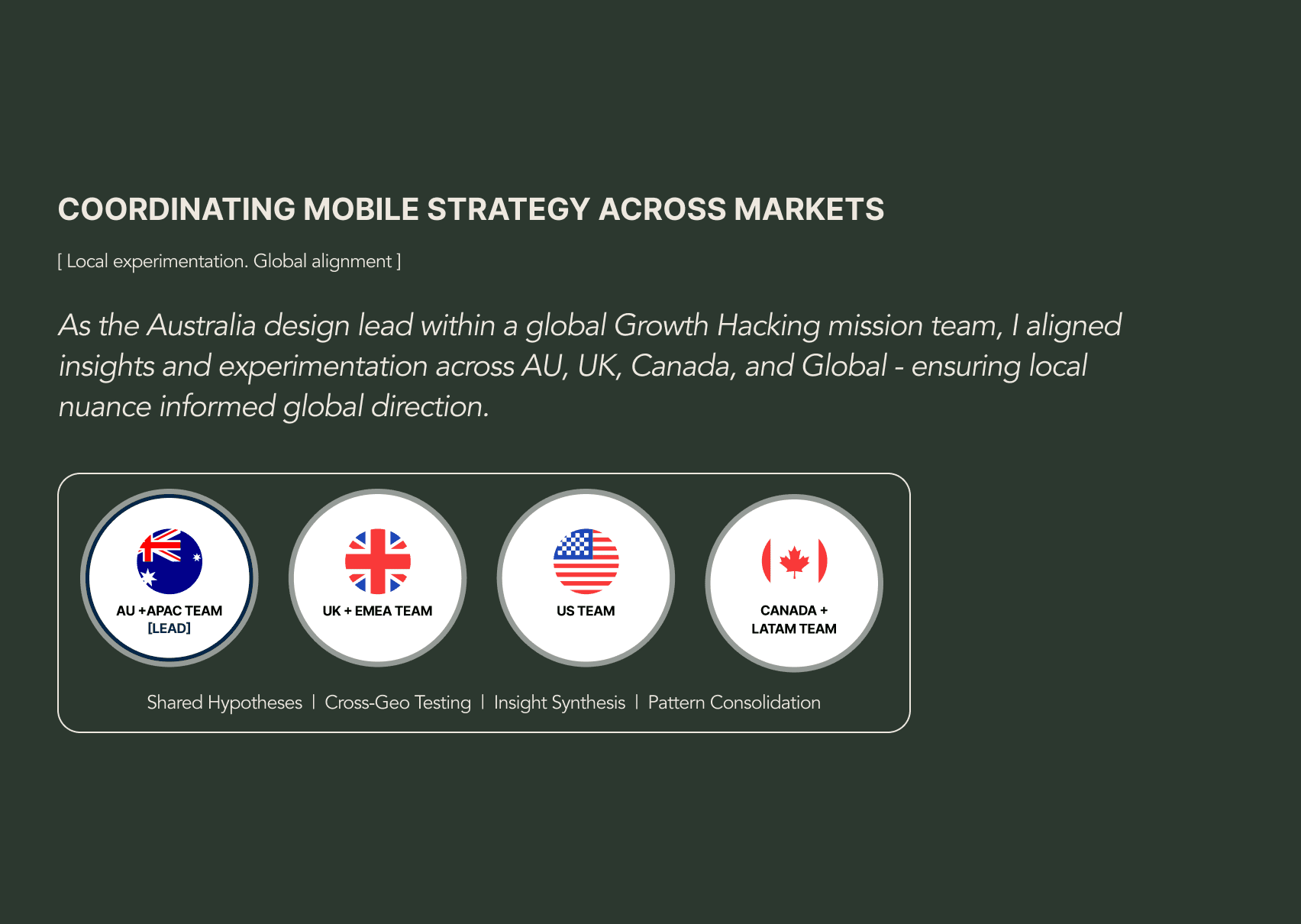
I was the Australia design lead within a global Growth Mission Team - a cross-functional initiative structured specifically for rapid testing and iteration across high-impact acquisition challenges.
My counterparts were design leads in the UK and Canada, each running localised experimentation within a shared strategic framework.
My contribution operated at two levels simultaneously, and I want to be clear about both.
At the strategic level I set and aligned the mobile-first design direction for AU and RoW, represented regional requirements in global discussions, synthesised learnings across geos, and ensured that winning patterns translated into reusable foundations rather than one-off test results.
At the craft level I personally designed mobile screens, landing page variants, and test executions for the Australian market. The strategic coordination and the hands-on design work weren't separate tracks - they informed each other continuously. Understanding what I was designing made me a better cross-geo collaborator. Being in the global conversations made me a sharper designer.
Before running a single test, the mission team aligned on a shared strategic reframe - one that changed how we thought about mobile entirely.
Designing for this meant prioritising context, clarity, and pacing over premature conversion.
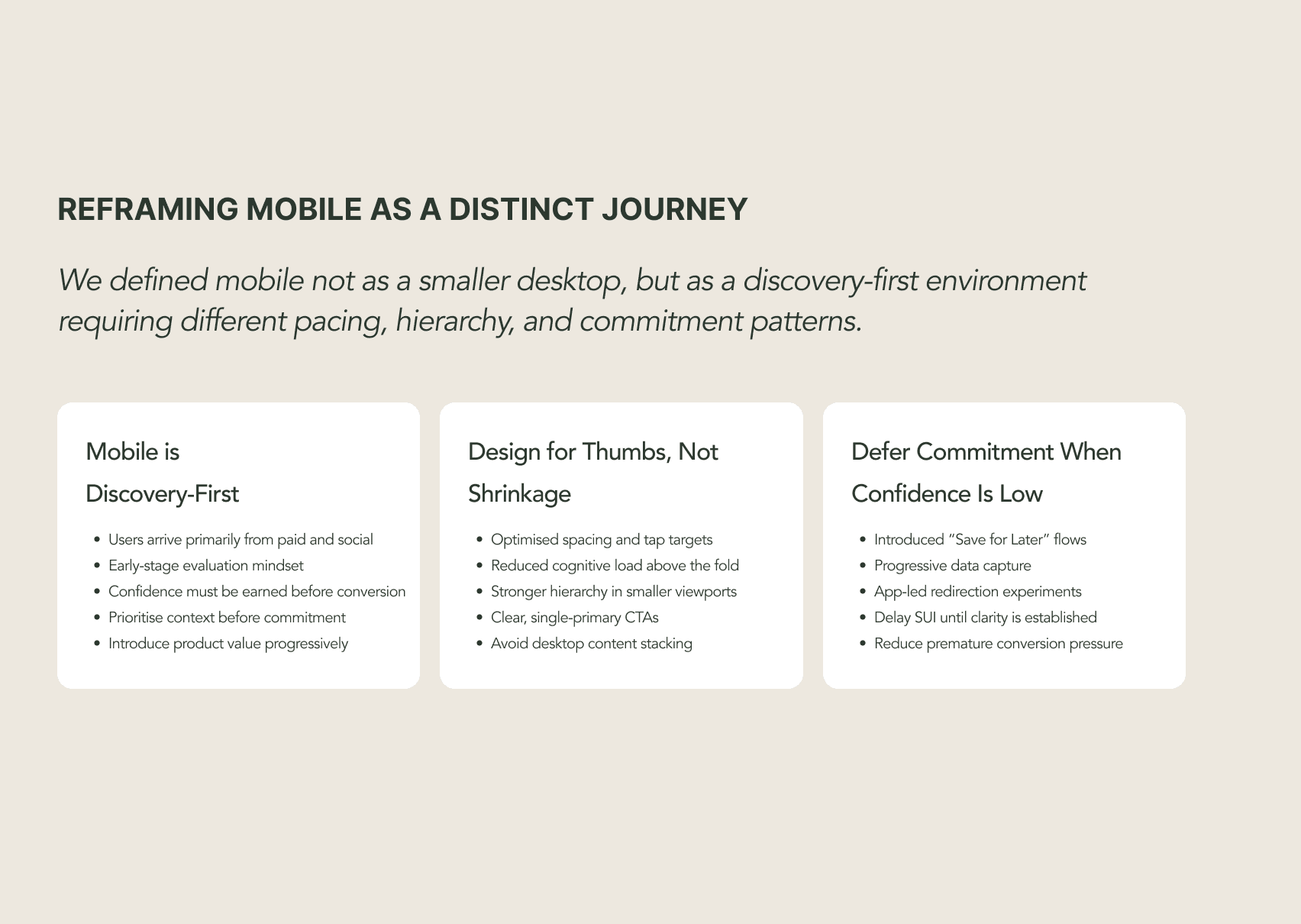
That reframe had three practical implications for how we designed:
First, layouts, typography, imagery, and interactions needed to be built specifically for mobile - not adapted down from desktop. Design for thumbs, not shrinkage.
Second, commitment needed to be deferred when confidence was low. We explored "save for later" flows, progressive data capture, and app-led redirection experiments for users who showed mobile-native behaviour.
Third, social proof and value articulation needed to land earlier in the journey, before users were asked to do anything.
This wasn't a list of UX best practices. It was a deliberate strategic position that ran counter to how mobile had been treated previously - as a responsive version of the desktop experience rather than a distinct acquisition channel with its own intent model.
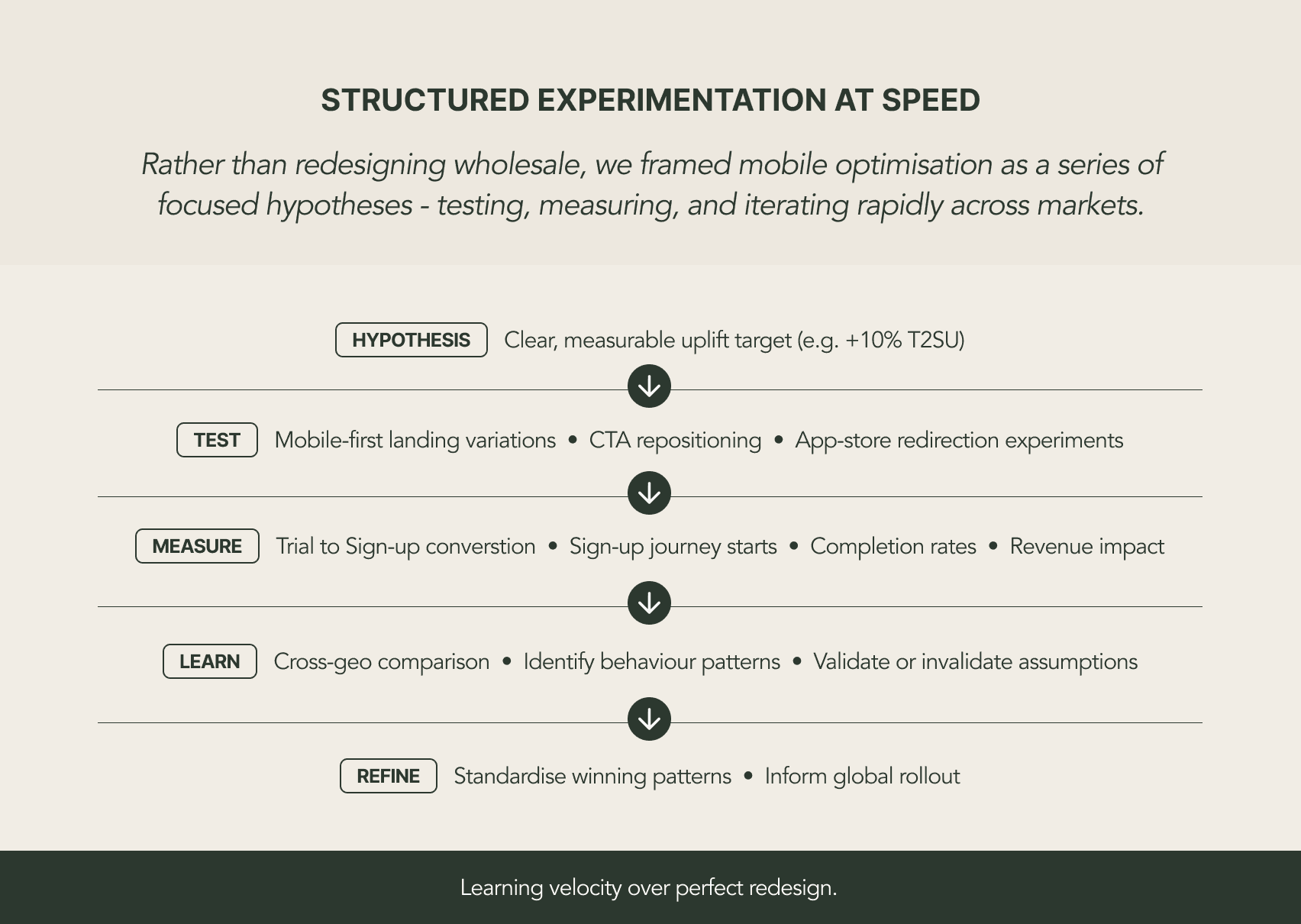
The mission team operated in a structured experimentation model: clear hypotheses, defined success metrics, rapid test cycles, cross-geo comparison, and pattern consolidation from what worked.
For the Australian market specifically, tests included mobile-first landing page variants with reordered content hierarchy and stronger value articulation above the fold, simplified and resequenced CTAs that delayed sign-up until users had sufficient context, experiments redirecting mobile users toward app store download flows where completion behaviour was stronger, and visual and interaction optimisations that reduced cognitive load in the first few seconds of a visit.
The discipline was learning velocity over perfect redesign. Relatively lightweight mobile-specific changes produced strong early signals - which reinforced that the unlock was strategic reframing, not wholesale visual overhaul.
The problem stated plainly: 60%+ of traffic on mobile, yet desktop held the conversion advantage. The gap was strategy, not capability.
The mission team structure: AU as lead, coordinating with UK, Canada, and US teams through shared hypotheses, cross-geo testing, and insight synthesis.
The strategic principles that underpinned all test execution: discovery-first, design for thumbs, defer commitment when confidence is low.
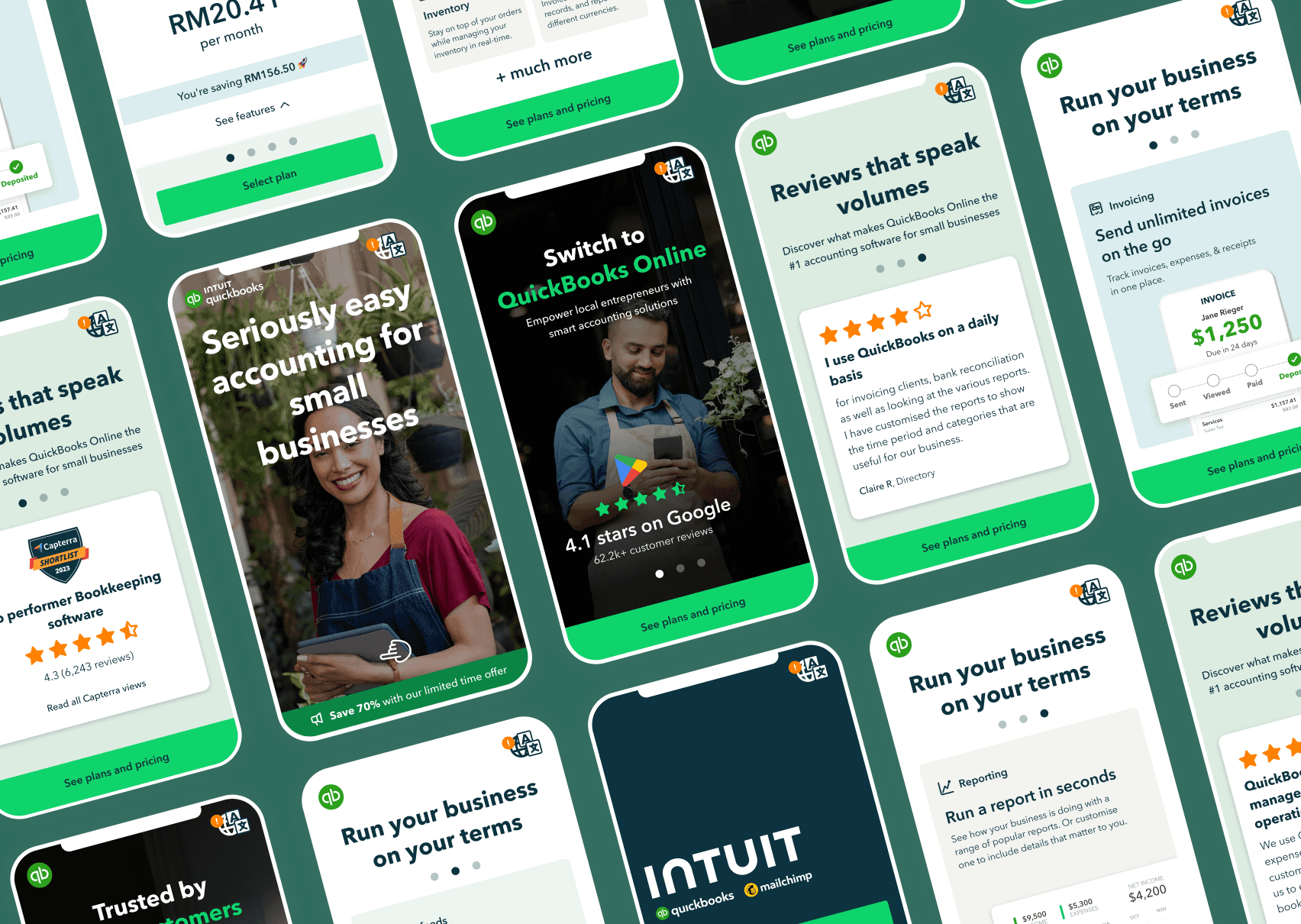
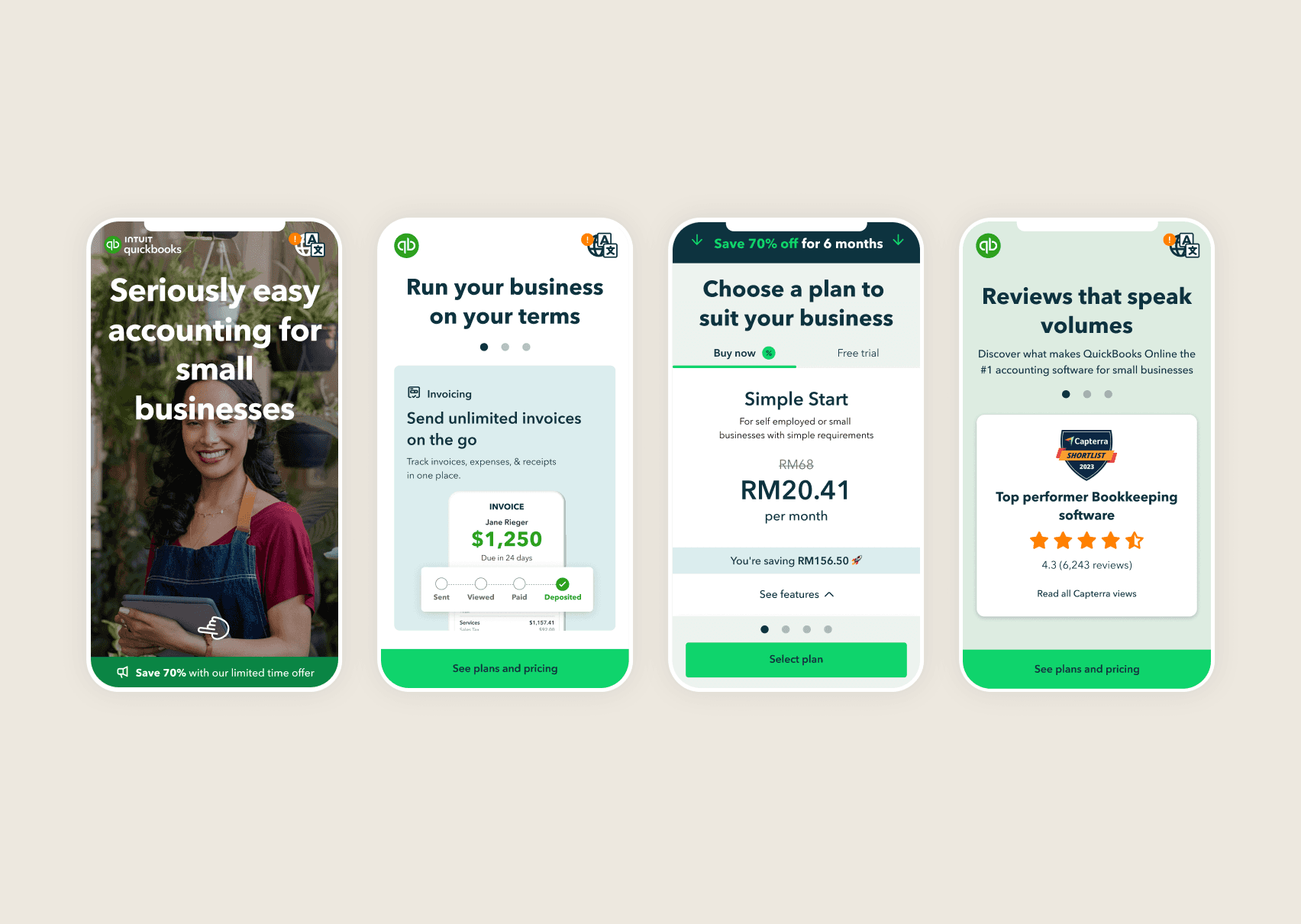
The work itself: mobile-first landing experiences designed for the Australian market, showing progressive value delivery, localised pricing, social proof prioritisation, and a CTA approach calibrated to user confidence rather than funnel position.
The operating model: hypothesis, test, measure, learn, refine. Learning velocity over perfect redesign.
The Australian results validated the strategic direction clearly.
These numbers are specific to the Australian market - the region I led and designed for directly. The UK and Canadian teams ran parallel experimentation within the same strategic framework, with their own regional executions and results.
The revenue per customer lift is the metric I find most meaningful. Improving top-of-funnel numbers is one thing. Improving downstream revenue per user suggests that building confidence before conversion doesn't just increase volume - it improves the quality of who converts. Users who understood what they were signing up for became better customers.
The most important design decision on this project wasn't a screen. It was the reframe - agreeing, before any design work started, that mobile users deserved a fundamentally different strategy rather than a responsively scaled version of the desktop experience.
When design teams are given the space to challenge assumptions about user intent, and the rigour to test those challenges with real evidence, the results compound.